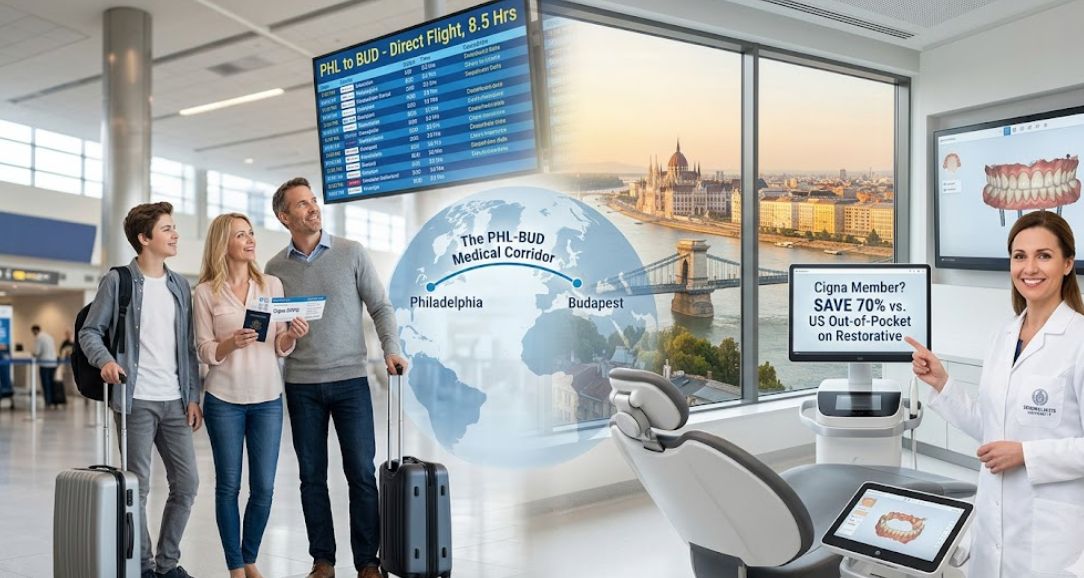
In the complex world of American employer-sponsored benefits, Cigna Healthcare has long been regarded as the “Globalist.” Unlike many of its domestic-only competitors, Cigna has spent decades building a massive international infrastructure. In 2026, as the lines between domestic healthcare and global medical tourism continue to blur, Cigna stands out as a unique—yet ultimately constrained—player in the dental market.
For residents of the American East Coast, particularly those near the Philadelphia (PHL) hub, Cigna represents a high-standard insurance product. However, for patients facing “Category III” major restorative work—implants, complex bridges, or full-arch reconstructions—even Cigna’s premium plans often hit a financial ceiling.
In this expert review, we will dissect the Cigna Dental PPO architecture, explore the limitations of its “Total Cigna DPPO” network, and explain why the new direct flight from Philadelphia to Budapest is becoming the essential “top-up” for Cigna members.
1. The Cigna Architecture: DPPO Advantage vs. Core
Cigna’s strength lies in its network tiers. In 2026, their Total Cigna DPPO network remains one of the most robust in the United States, providing access to over 150,000 unique dental providers.
The Advantage Tier
This is Cigna’s most popular level. Providers in this tier have agreed to deeply discounted fee schedules. For the patient, this means that even before the insurance pays a cent, the “sticker price” of the dental work is reduced by the Cigna contract.
The Core Tier
The Core tier is wider but slightly more expensive. The genius of Cigna’s 2026 model is the “Cigna Dental Oral Health Integration Program.” This is a unique feature that offers 100% reimbursement for certain procedures (like extra cleanings or fluoride treatments) for people with specific medical conditions like heart disease or chronic kidney disease.
2. The 2026 Reality: The “Cliff” of Major Coverage
Despite Cigna’s industry-leading wellness perks, the “Major Restorative” category remains the Achilles’ heel of the policy.
In 2026, a “High-Option” Cigna plan typically carries an Annual Maximum of $2,000 to $2,500. While this is higher than the industry average of $1,500, it is still insufficient for the technological reality of modern dentistry.
Why the Math Doesn’t Work for Implants
If a Cigna member in the Philadelphia suburbs needs a full-arch restoration (the “All-on-4” procedure):
-
US Market Cost: ~$25,000 – $35,000 per arch.
-
Cigna’s Contribution: Even with a premium 50% coverage rate for major work, the policy will stop paying once it hits the $2,500 cap.
-
The Patient’s Burden: ~$22,500+ out of pocket.
This “Insurance Cliff” is precisely where the global perspective of a Cigna member becomes an advantage.
3. The Philadelphia-Budapest Gateway
For a Cigna member, “Global” is a brand they already trust. This makes the transition to Budapest, Hungary, a natural evolution of their healthcare strategy.
With the 2026 launch of direct daily flights from Philadelphia International Airport (PHL) to Budapest (BUD), the East Coast patient is no longer tethered to local prices. Budapest is not just a “cheaper” option; it is the European center of excellence for prosthodontics and oral surgery.
The Cigna Member’s Budapest Advantage
Top-tier clinics in Budapest—frequently visited by American patients—operate with a level of transparency that mirrors US corporate healthcare.
-
Standards: These clinics are ISO-certified and often employ surgeons trained at Semmelweis University, a world-leading institution for dental research.
-
Technology: While your local US dentist might refer you out for a 3D CT scan, Budapest clinics are “all-in-one” hubs where the CT scan, the digital lab, and the surgical suite are in the same building.
4. Comparing the Costs: US Cigna vs. Budapest
For the savvy Cigna member, the goal is to maximize the insurance for “Maintenance” while utilizing Budapest for “Investment.”
| Procedure | US Out-of-Pocket (After Cigna Cap) | Budapest Total Cost |
| Zirconia Crown | $900 – $1,200 | $400 – $550 |
| Single Dental Implant | $3,500 – $5,000 | $1,100 – $1,300 |
| Full Mouth Restoration | $22,000+ | $8,000 – $10,000 |
For a patient requiring a full mouth restoration, the savings are not just “significant”—they are life-changing, often exceeding $15,000 even after accounting for the PHL-BUD airfare and a stay at a 5-star hotel like the Four Seasons Gresham Palace.
5. Can You Use Cigna Benefits Abroad?
One of the most frequent questions from US patients is: “Will Cigna pay for my work in Budapest?”
-
Out-of-Network Claims: Most Cigna DPPO plans allow for out-of-network care. Because Budapest clinics are technologically advanced, they provide itemized, English-language invoices with internationally recognized dental codes (CDT codes). Patients can submit these to Cigna for reimbursement against their annual maximum.
-
Strategic Splitting: We recommend using your Cigna “In-Network” benefits for your annual checkups and cleanings in the US. This keeps your local records up to date. Then, use your “Passport” for the high-cost surgical work that your US insurance cannot adequately cover.
-
HSA/FSA Integration: In 2026, using Health Savings Account funds for dental tourism is a mainstream financial move. Since dental care in Budapest is a legitimate medical expense, it can be paid for with pre-tax dollars, adding another 20-30% in effective savings for the patient.
6. The “Dental Vacation” Experience: Recovery in Budapest
A unique aspect of the Budapest dental corridor is the recovery process. Budapest is the “City of Spas,” famous for its thermal waters. For a patient who has just undergone a major implant procedure, the stress-reducing environment of a Budapest spa is more than just a luxury—it is a physiological aid to healing.
Instead of recovering on a couch in a Philadelphia suburb, Cigna members find themselves recovering in the architectural grandeur of the Széchenyi or Gellért baths, where the mineral-rich waters have been used for centuries to aid inflammation and wellness.
7. Quality Control: The Semmelweis Standard
Patients often worry about “low cost” equaling “low quality.” In Budapest, the opposite is often true. Because the volume of dental tourism is so high, surgeons in Budapest often have more hands-on experience with complex implant cases than the average US general dentist.
Furthermore, Budapest clinics utilize the same premium Swiss and Swedish implant systems (such as Straumann or Nobel Biocare) that are considered “top tier” in the United States. You aren’t getting a “cheaper” implant; you are getting the same implant at a European price point.
8. Final Expert Verdict: The 2026 Cigna Strategy
Cigna Healthcare Dental is one of the best preventative tools available to the American worker. Its emphasis on the link between oral health and systemic disease makes it a forward-thinking choice for maintaining a healthy smile.
However, Cigna members must be realistic about the $2,500 barrier. If your dental treatment plan involves an “All-on-4” or multiple implants, you are facing a massive out-of-pocket expense that no domestic insurance can solve.
With the new direct flight from Philadelphia to Budapest, the solution is a 9-hour journey across the Atlantic. By combining your Cigna coverage for routine care with Budapest’s expertise for major restorative work, you can achieve a level of dental health that was once reserved only for the wealthy.
The Expert Recommendation: Don’t let your insurance cap define your health. Use Cigna to stay healthy, and use Budapest to get your smile back.